Louisville Metro Department of Corrections | May 2026
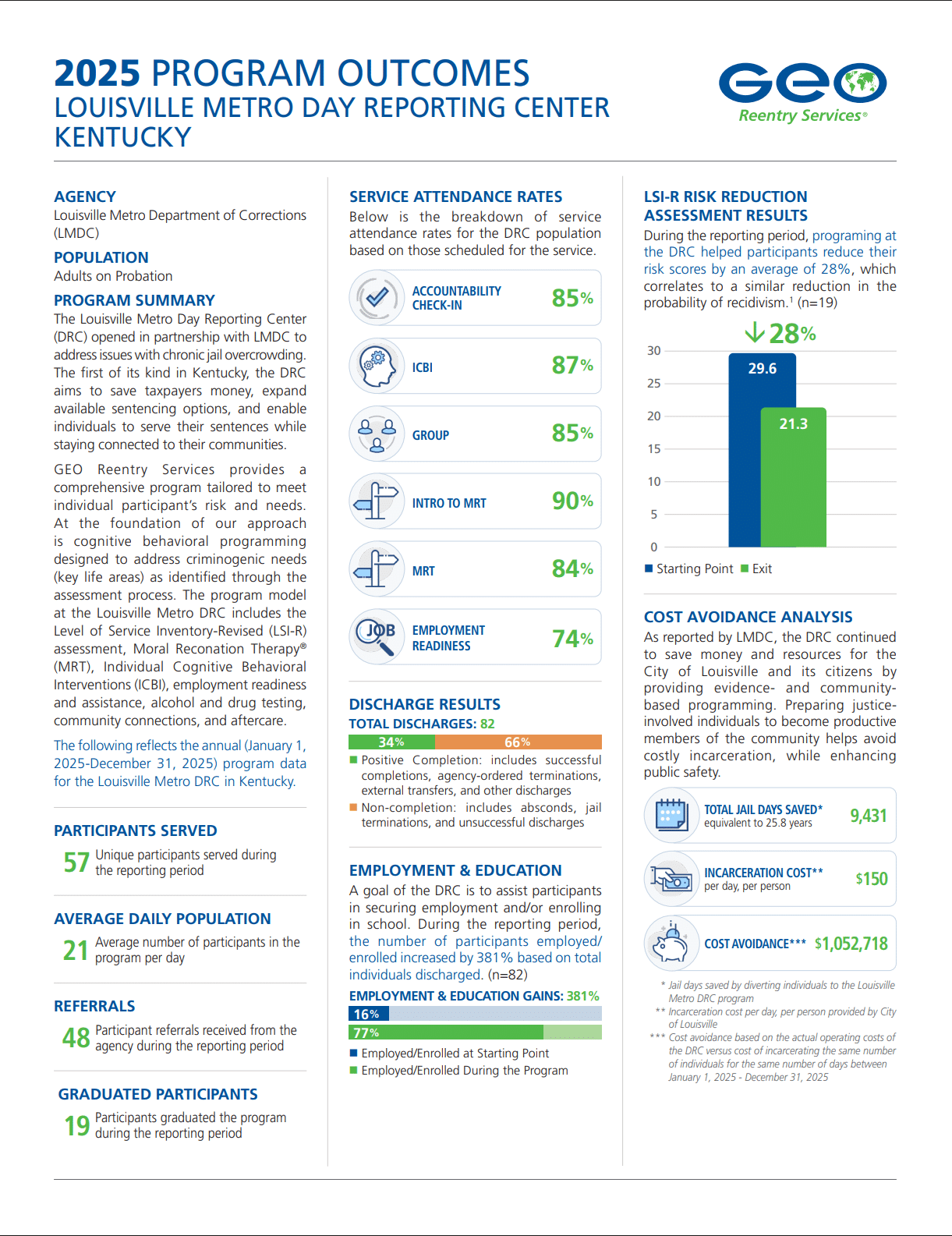
A new outcome report highlights program data for calendar year 2025. Findings include that the program reduced criminal risk among participants by an average of 28%, had excellent engagement measured by high service attendance rates, more than quadrupled the number of individuals employed, and helped the agency save more than $1 million in jail-avoidance costs.
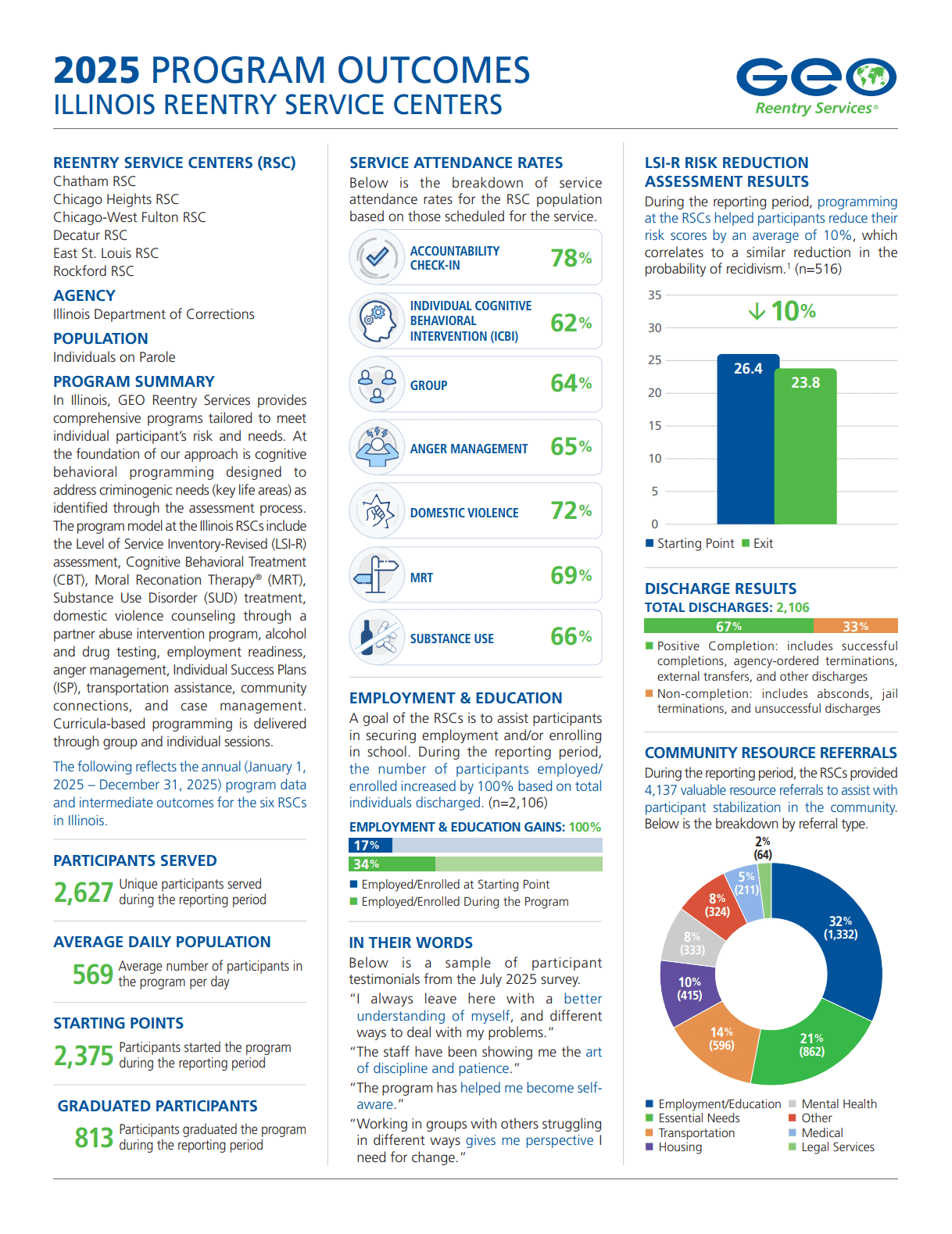
GEO Reentry has operated reentry programs in Illinois for more than two decades. This report details data for the calendar year 2025. Measuring pre- and post-programming scores for 275 program participants, research analysts found a 10% reduction in criminal thinking patterns across the five domains, suggesting that the program helps reduce the potential for future recidivism.
This report assesses data of individuals who participated in the program during calendar year 2025. During this time, the program helped participants obtain stable employment, more than doubling the number of individuals employed. The report also shows there was also a 16% decline in criminal risk among a sample of participants.
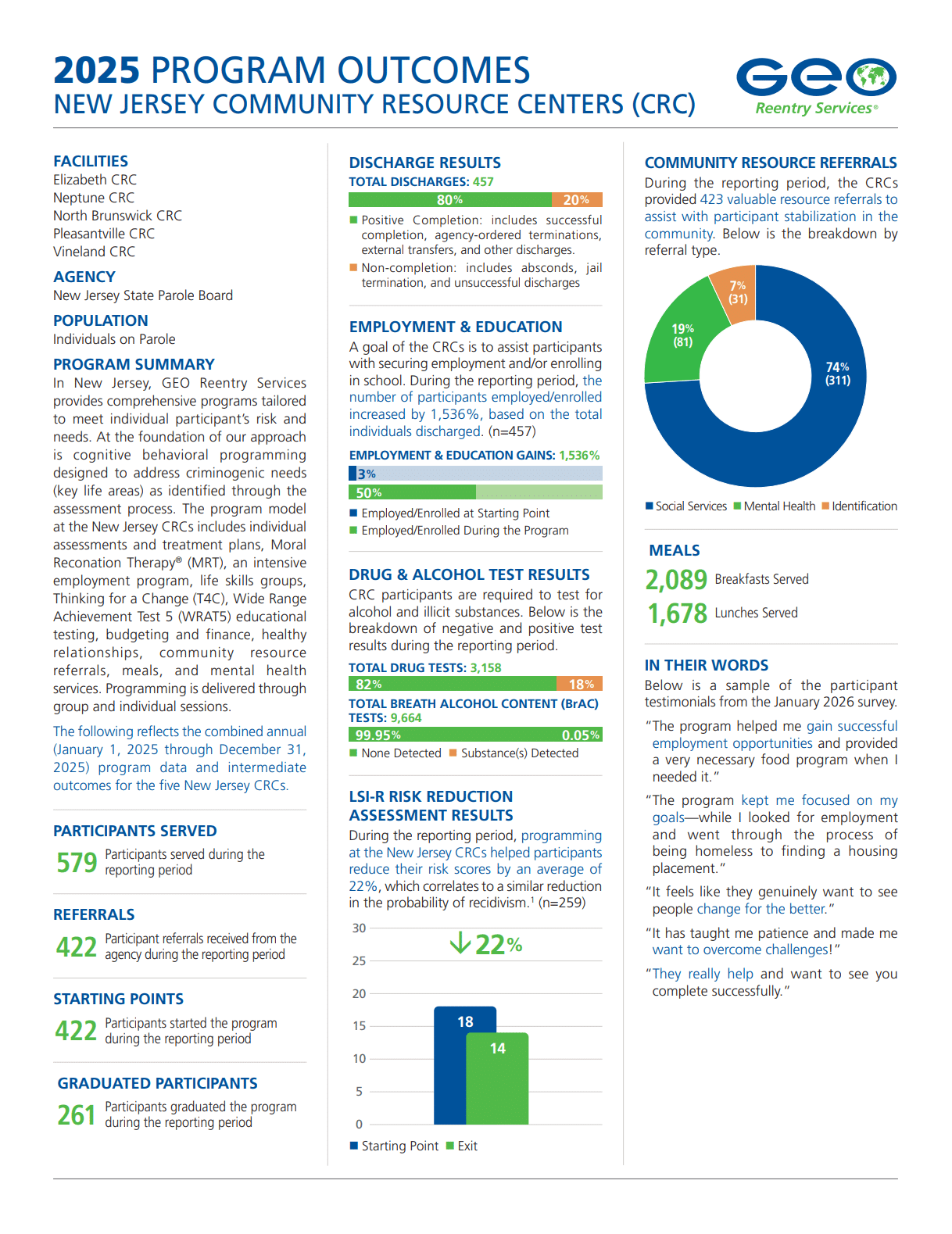
GEO Reentry operates five centers in New Jersey that deliver evidence-based treatment and reentry services. During the calendar year 2025, the centers served 579 participants. The data highlights a 22% risk reduction as measured by the LSI-R assessment and an 80% positive completion rate.
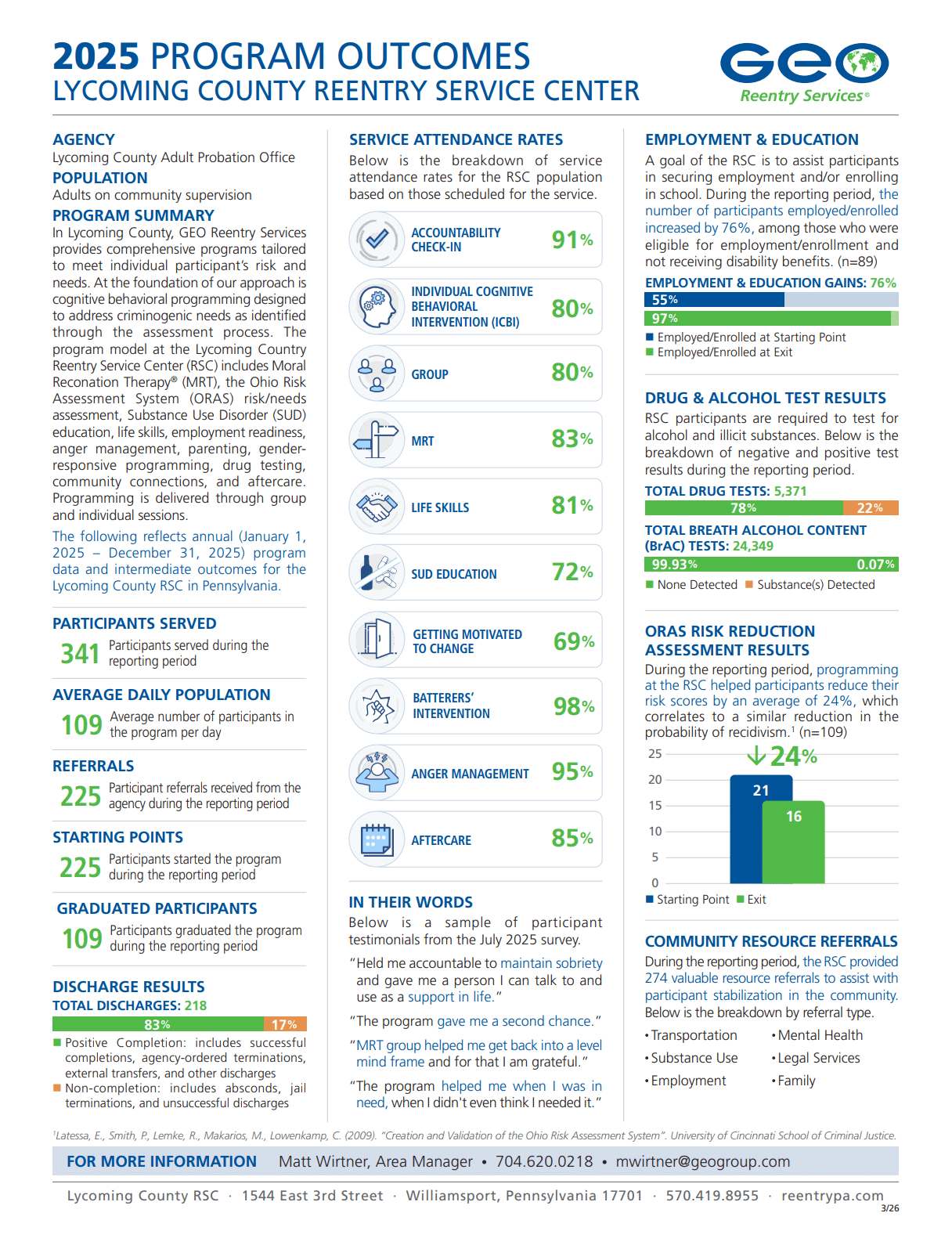
Lycoming County Adult Probation Office | March 2026
This report assesses data of individuals who participated in the program during calendar year 2025. During this time, the Lycoming County program helped participants obtain stable employment, nearly doubling the number of individuals employed. The report also shows a 24% risk reduction as measured by the ORAS assessment and a high positive completion rate.
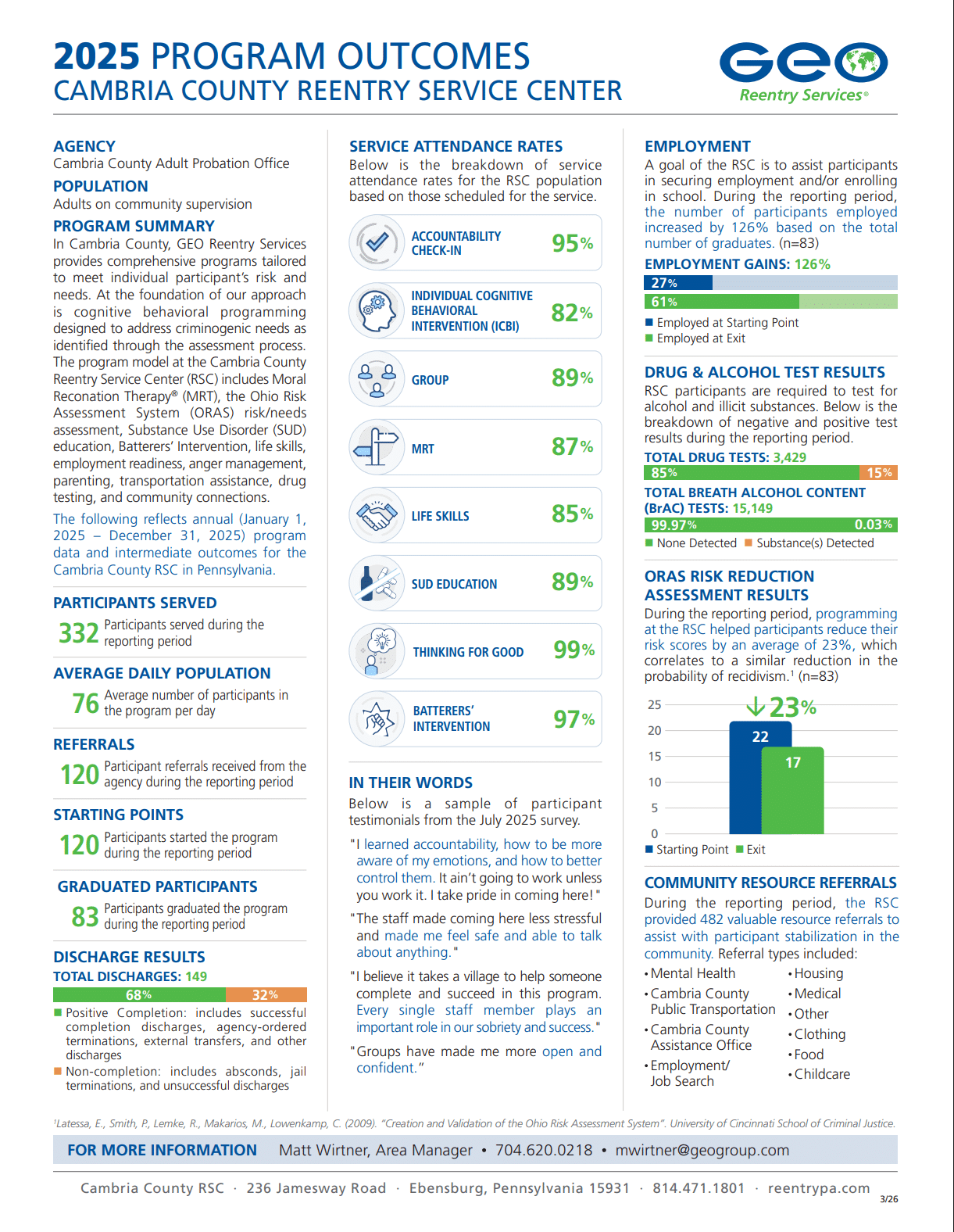
Cambria County Adult Probation Office | March 2026
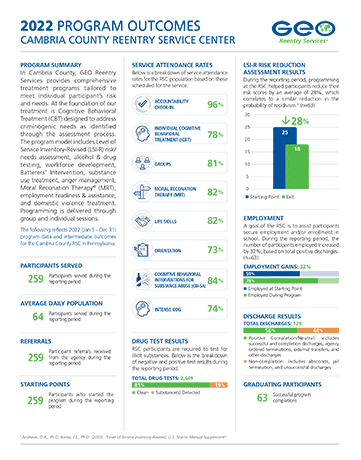
A new outcome report for the Cambria County RSC highlights participant data for the 2025 calendar year. The report highlights that during the reporting period, the number of housed participants increased by 20% and number of individuals who gained employment more than doubled.
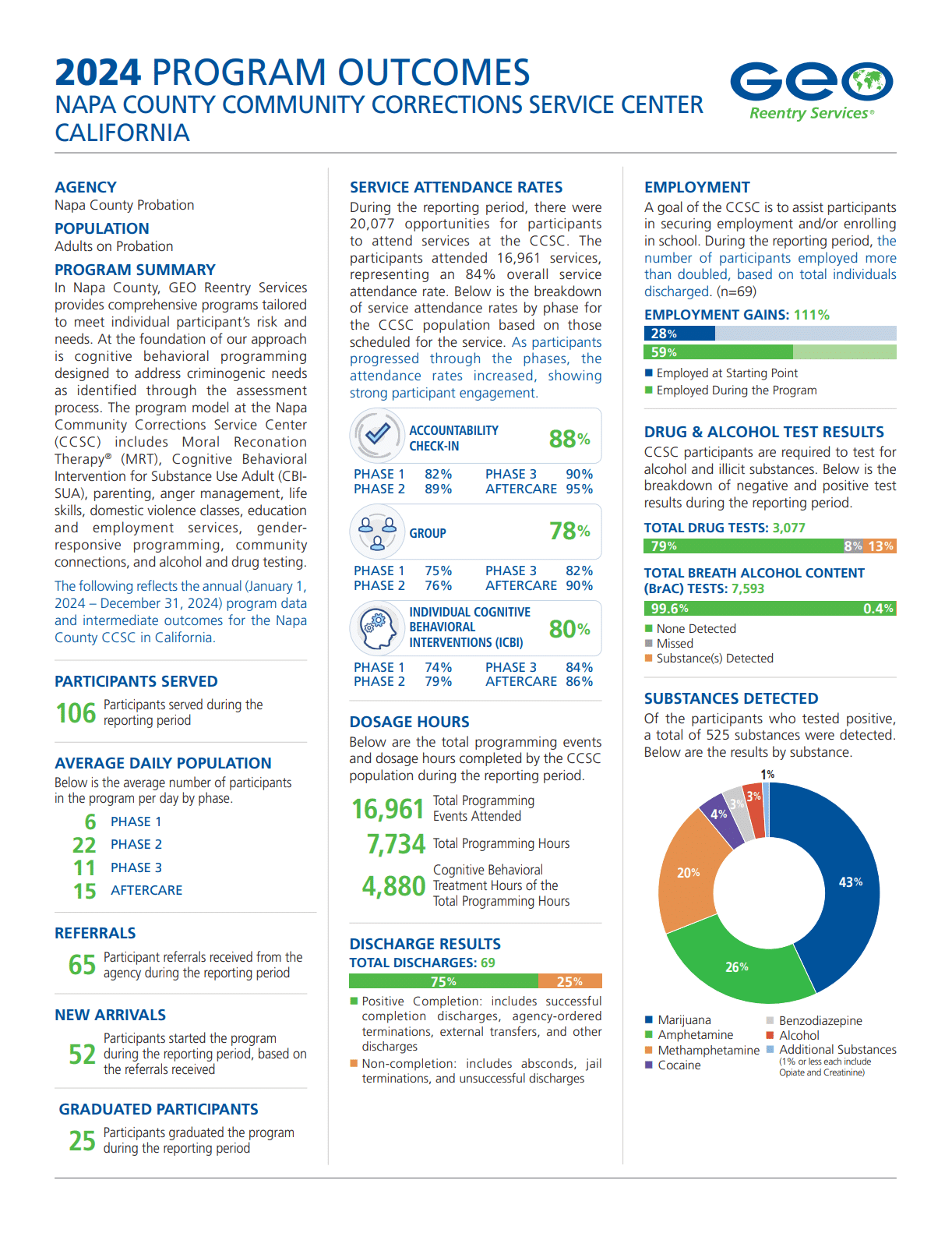
This report assesses data of individuals who participated in the program during calendar year 2024. During this time, the program helped participants obtain stable employment, more than doubling the number of individuals employed. The report also shows there was also a 28% decline in criminal risk among a sample of participants.
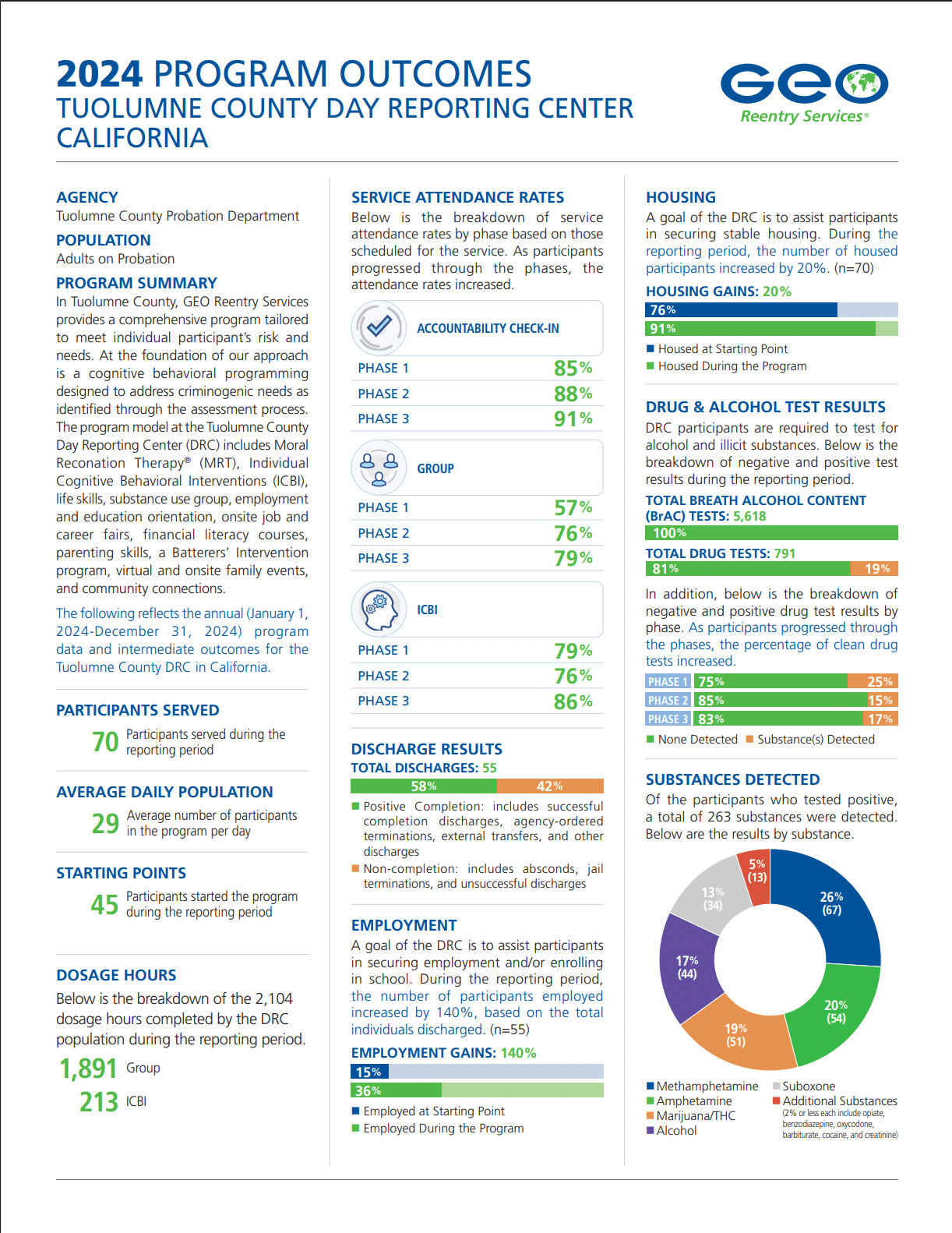
Tuolumne County Probation Department | December 2025
A new outcomes report for the Tuolumne County DRC highlights participant data for the calendar year 2024. The report highlights that during the reporting period, the number of housed participants increased by 20% and number of individuals who gained employment more than doubled.
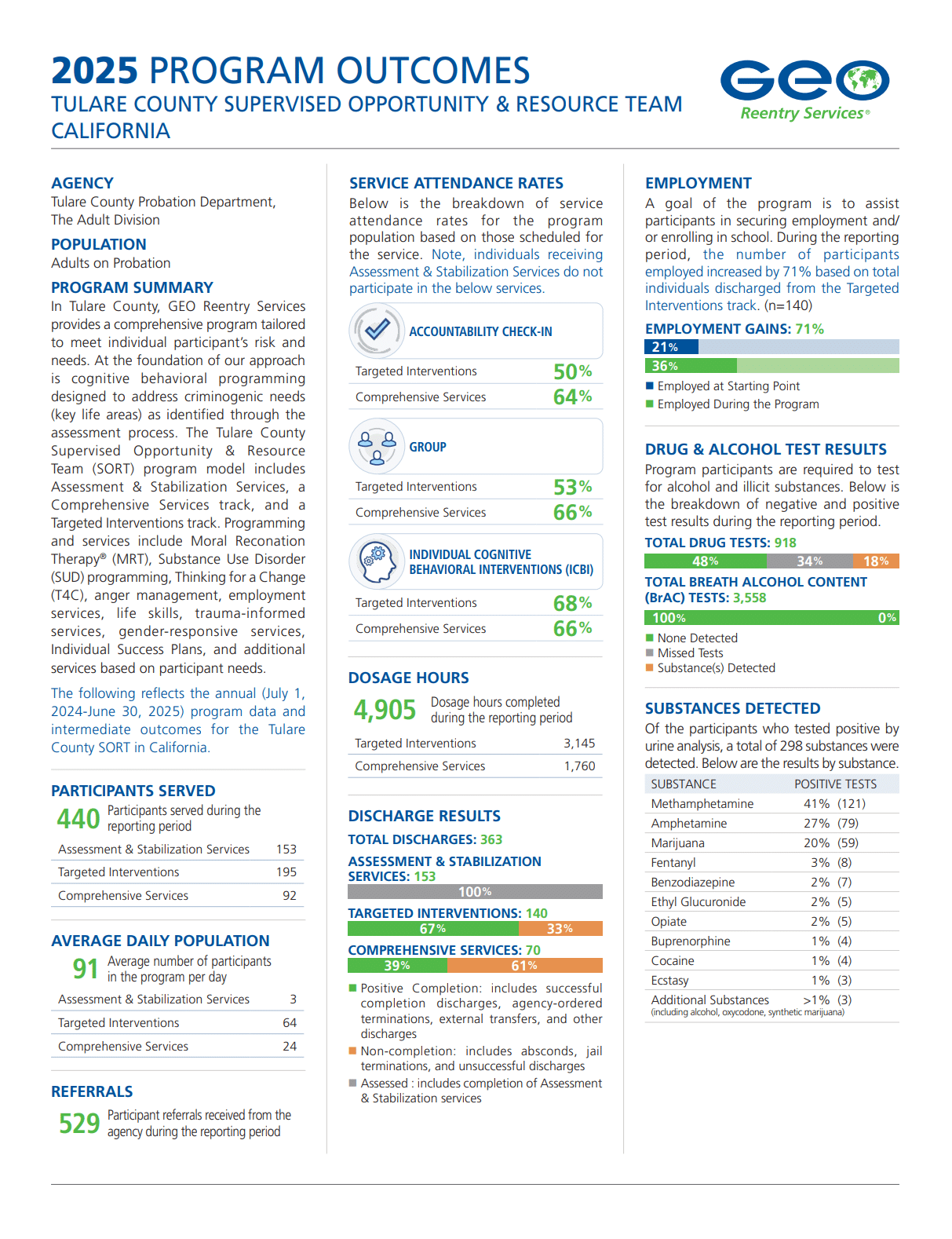
Tulare County Probation Department, The Adult Division | November 2025
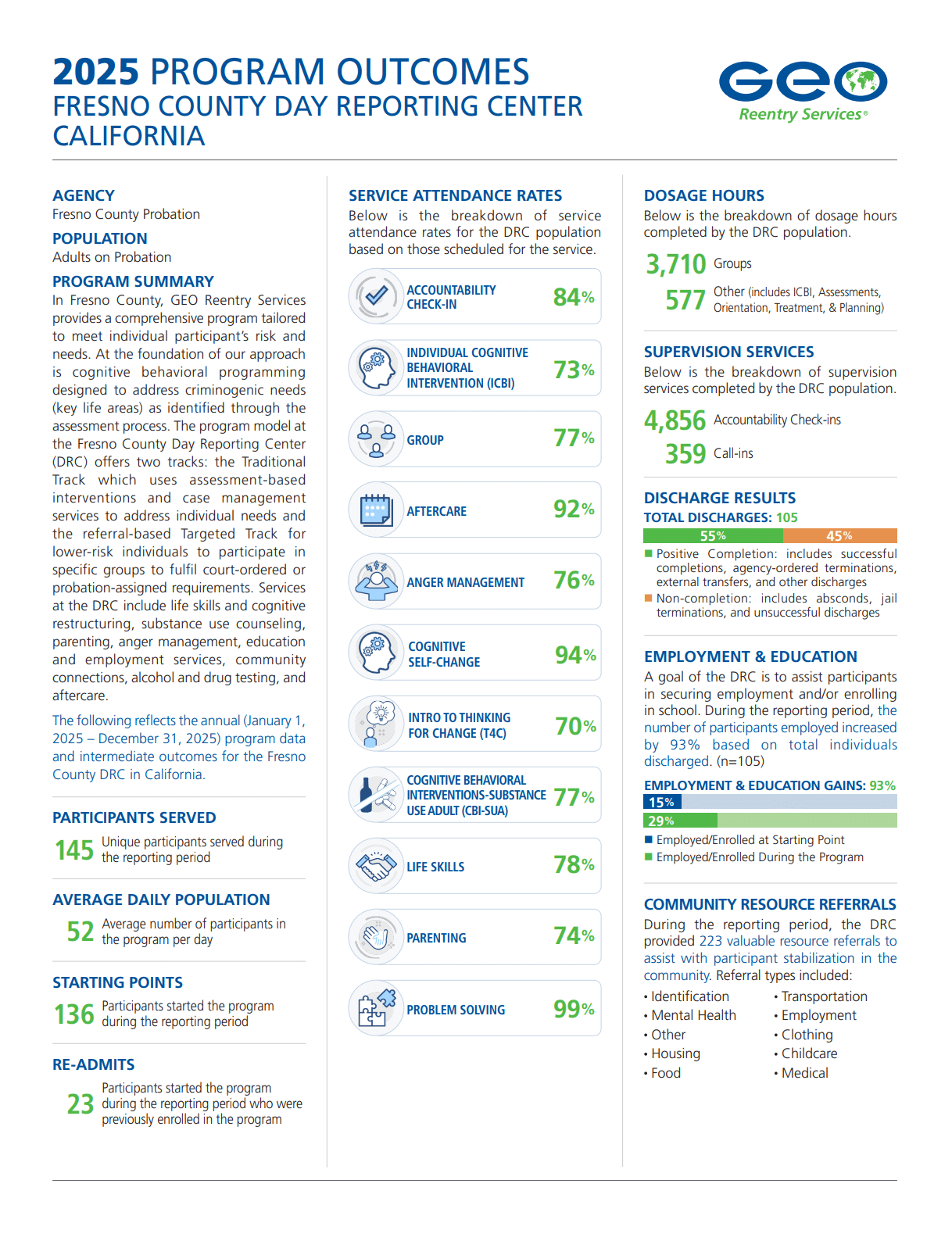
A new outcomes report for this reentry program focused on participant data for the calendar year 2025. The report highlights that 529 individuals were referred to the program and the program had an average daily population of 91. There was a 20% decrease in criminal thinking patterns among a sample of participants, and overall employment gains were 71%.
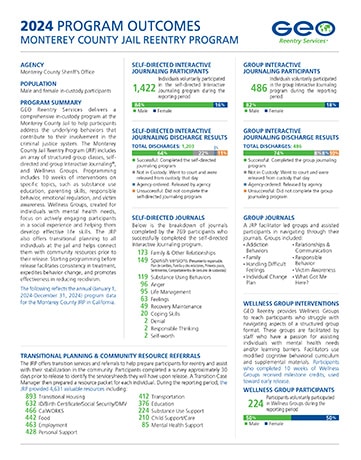
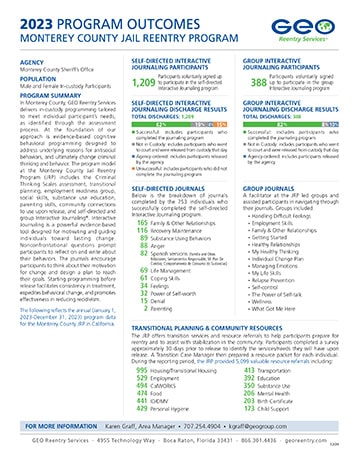
GEO Reentry delivers in-custody programming that focuses on changing criminal thinking and behavior in the Monterey jail. This report highlights data collected in the calendar year 2024. Of note, more than 1,400 participants voluntarily enrolled in a self-directed journaling program, and 64% completed it. For a group interactive journaling program, almost 500 enrolled and 74% completed. The report also highlights the number of referrals made by the community organization and a Wellness Group.
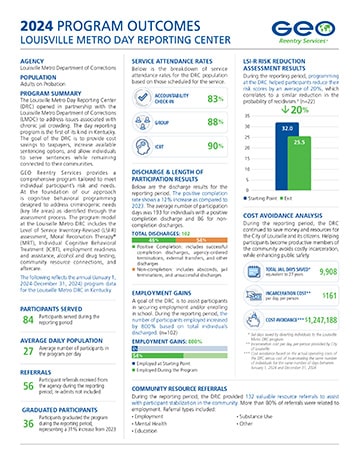
Louisville Metro Department of Corrections | April 2025
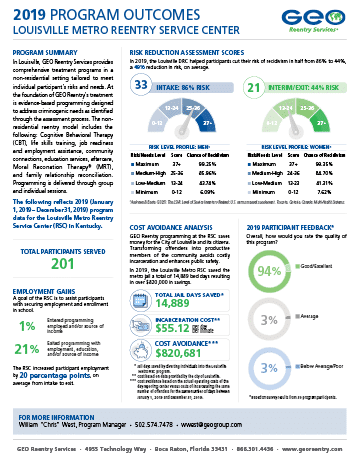
The Louisville Metro DRC was opened to reduce recidivism and lower incarceration costs. This outcomes report captured data during the calendar year 2024, and finds the program reduced criminal risk among a sample group of participants by 20% as measured by the LSI-R. Eighty-four participants were served during the year and the agency estimates more than $1.2 million had been saved in avoided incarceration costs. In addition, participants at discharge achieved major employment gains.
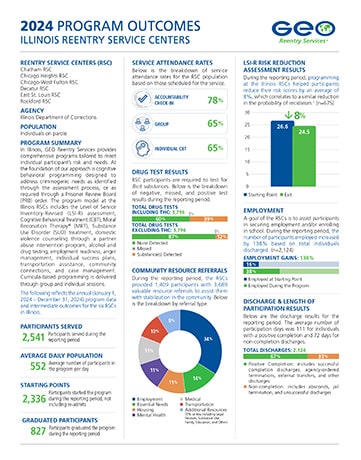
This 2024 data report reviews services delivered in 2024 at six day reporting programs and assesses how participants performed in key areas, such as criminogenic risk, employment, drug and alcohol use, and overall engagement with center activities. During the year, 2,541 participants were served and criminal risk scores for a sample group were reduced by 8% using the LSI-R. Also, employment gains for discharged participants rose 138%.
Luzerne County Adult Probation & Parole | March 2025
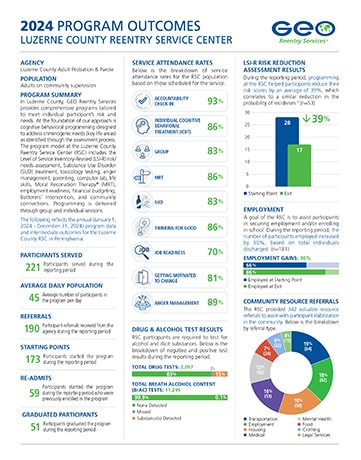
GEO Reentry operates a reentry program for the Luzerne Probation Department, in which adult participants undergo treatment, training and connections to local resources. This report assesses data from the calendar year 2024 in which 221 individuals were served. When assessing a sample group of participants, there was a 39% criminal risk reduction as measured by the LSI-R. The report highlights strong engagement among participants, results of more than 13,000 drug and alcohol tests, and referrals made to community resources by type.
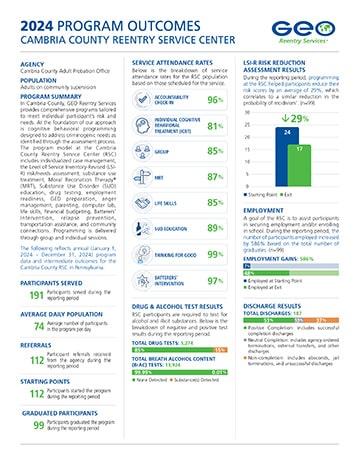
GEO Reentry has operated the RSC for the probation department for more than a decade. This report assesses data points for 191 participants who entered the program in 2024. It finds very positive engagement results, including a 99% Thinking for Good attendance rate, positive results in more than 17,000 drug and alcohol tests, and major employment gains for discharged participants. When assessing a sample from program completions, there was a 29% criminal risk reduction as measured by the LSI-R.
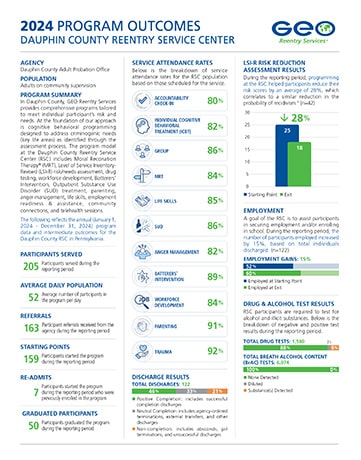
GEO Reentry has operated the RSC for the probation department since 2014. This report assesses data points for 205 participants who entered the program in calendar year 2024. It finds attendance rates in 11 categories above 80%, more than 1,500 drug tests administered and only 9% positives, and employment gains of 15% for discharged participants. Importantly, when assessing a sample of program participants, there was a 28% criminal risk reduction as measured by the LSI-R.
Lycoming County Adult Probation Office | February 2025
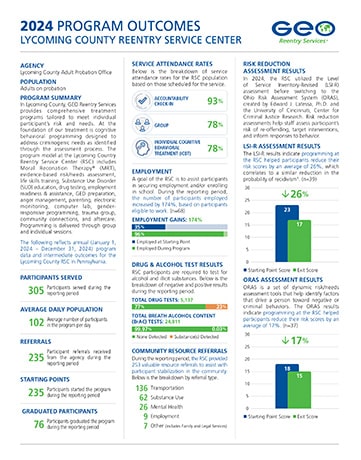
A new outcomes report for this reentry program focused on participant data for the calendar year 2024. The report highlights that 305 individuals were referred to the program and the center had an average daily population of more than 100. Importantly, data shows that criminal risk was reduced for a sample of participants by 26% using the LSI-R. The program achieved a 93% accountability check-in rate, and participants saw major gains in employment.
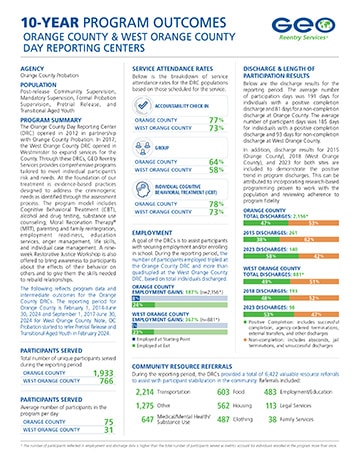
GEO Reentry operates two DRCs for the Orange County (Calif.) Probation Department. This report assesses outcomes data over a 10-month period for the Orange County DRC ending June 30, 2024, and a seven-year period for the West Orange DRC location. Highlights include service data for 2,700 individuals referred to these centers, finding positive results in participant attendance, discharge data, substance usage, and community referrals. Most importantly, using pre- and post-program data, participants in sample groups had lower criminal risk scores using TCU’s Criminal Thinking Scales.
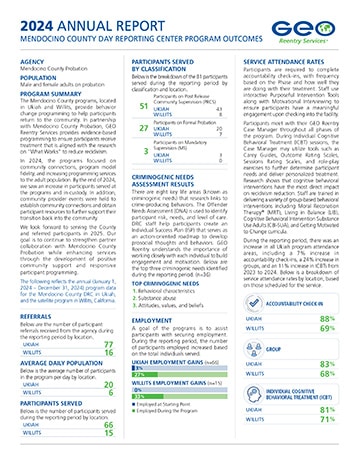
GEO Reentry manages two Day Reporting Center locations for the county for male and female individuals on probation. This report assesses data from the calendar year 2024 when 81 participants were served at the centers. The report finds significant employment gains, and positive accountability measures, including lower drug and alcohol usage rates and high attendance rates. The report delves into referrals made for services, such as housing, and demographics. Over a three-year period, the recidivism rate for graduates was 36%, lower than traditional probation.
North Carolina Department of Adult Correction | January 2025
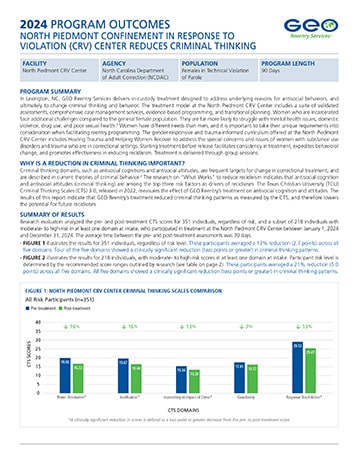
In North Carolina’s Confinement in Response to Violation Centers, GEO Reentry uses the Texas Christian University Criminal Thinking Scales to measure the effect of programming on antisocial cognition and attitudes. This report explores how programming has reduced criminal thinking significantly between pre- and post-treatment for two sets of female participants: all participants and a subset considered moderate to high-risk.
GEO Reentry delivers in-custody programming that focuses on changing criminal thinking and behavior. This report highlights data collected in the calendar year 2023. Of note, more than 1,200 participants voluntarily enrolled in a self-directed journaling program, and six of 10 completed it. For a group interactive journaling program, almost 400 enrolled and eight in 10 completed. The report also highlights the number of referrals made by the community organization.
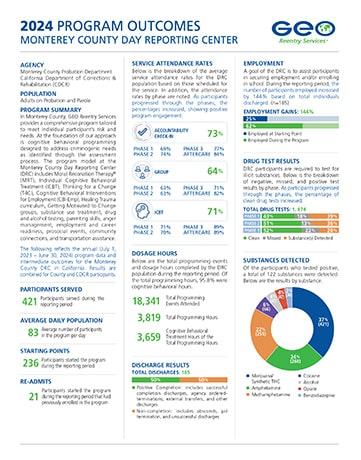
Participants are referred to the GEO Reentry DRC by the probation department and California Department of Corrections & Rehabilitation. This report assesses data for 421 participants who entered the program between July 1, 2023, and June 30, 2024. It finds positive engagement results with more than 18,000 programming events attended, a reduction in criminal thinking patterns using the TCU’s Criminal Thinking Scales, and significant gains in employment for individuals who completed the program successfully.
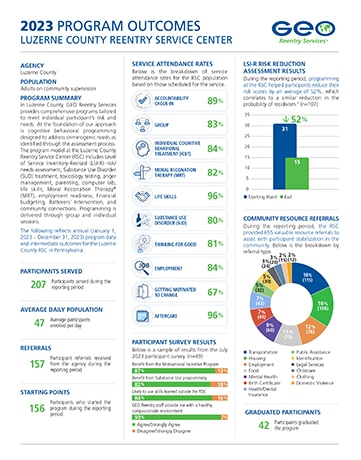
GEO Reentry operates a reentry program for the Luzerne Probation Department, in which adult participants undergo treatment, training and connections to local resources. In calendar year 2023, 207 individuals were served. Of note, when assessing 106 successful program completions during this year, there was a 52% risk reduction as measured by the LSI-R. Reduction in criminal thinking was reduced for a high-risk subset of participants also. Participants also made large strides in finding jobs before exiting the program.
GEO Reentry operates seven centers in Idaho that deliver evidence-based treatment and reentry services. This report reviews data from the seven Connection and Intervention Station programs as well as a Transitional Housing program operated by GEO Reentry in Idaho. In 2024, more than 1,700 individuals were served at CIS locations, and the results of both LSI-R and Criminal Thinking Scales assessments of subsets of these participants found reductions in criminal risk and thinking patterns. The Transitional Housing program placed almost 1,800 individuals during the year.
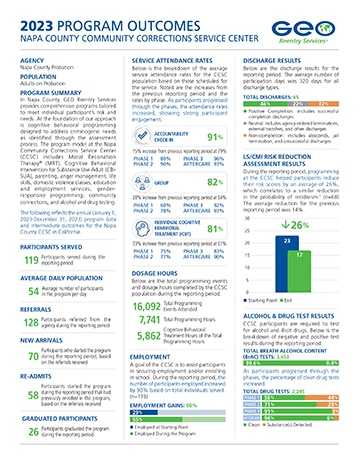
GEO Reentry has managed this reentry program for the county for more than a decade. This report assesses data of individuals involved in the program during calendar year 2023. During this time, 119 individuals received services, with an average daily population of 54. There was a 26% decline in criminal risk among a sample of participants, and overall employment gains were 90%. A pre- and post- analysis of a subset of individuals found a 9% reduction in criminal thinking patterns.
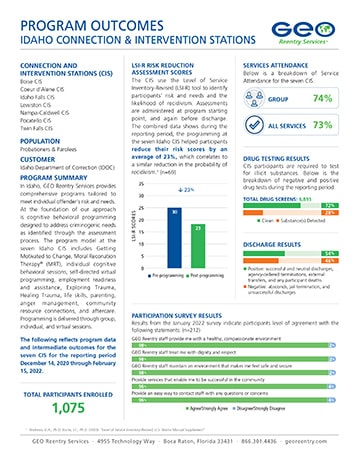
GEO Reentry operates seven centers in Idaho that deliver evidence-based treatment and reentry services. This report reviews aggregate data for 1,075 participants enrolled at one of Idaho’s Connection and Intervention Station programs from Dec. 14, 2020, through Feb. 15, 2022. The results of both LSI-R and Criminal Thinking Scales assessments of subsets of these participants found significant reductions in criminal risk and thinking patterns and positive service attendance.
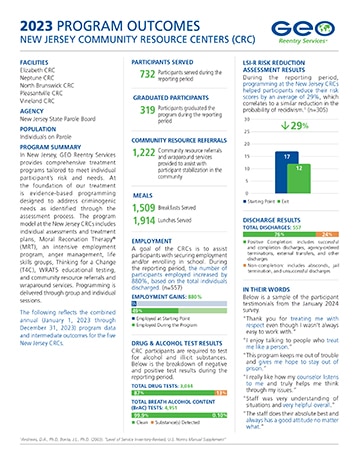
GEO Reentry provided reentry services at five service center locations during calendar year 2023 to 732 individuals on parole. This report assesses attendance rates, drug tests, referrals made to outside community resources, employment, and risk levels. Assessing criminal risk scores among participants, pre- and post-program data, the report found major gains among participants in reducing risk and criminal thinking levels. Huge gains were recorded among graduates in employment status.
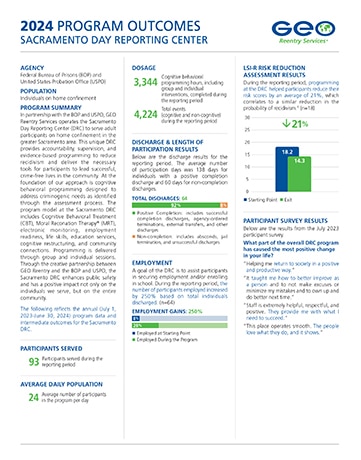
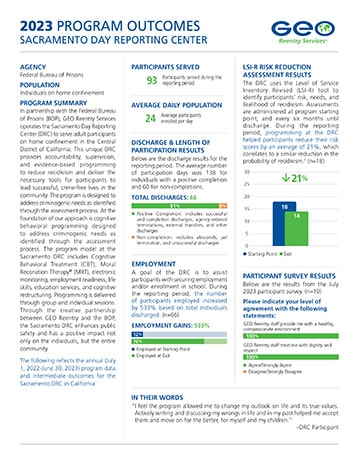
The Sacramento DRC provided services to 93 participants, with an average daily population of 24 over a one-year period, ending June 30, 2024. This report finds a significant change in participants, including a 21% reduction in risk score, significant employment gains from when a participant entered the program until completion, and a positive discharge for 92% of individuals who exited the program.
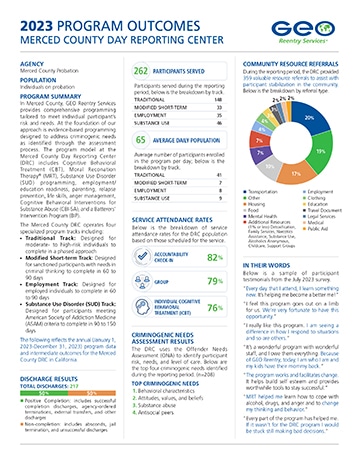
GEO Reentry operates both a day reporting center and jail reentry program for Merced County Probation and the Merced County Sheriff’s office, respectively. This report focused primarily on adults in the DRC program. During the calendar year 2023, 262 individuals were served with an average daily population of 65. The DRC offers four tracks for individuals: traditional programming, short-term, employment and substance use. A review of a subset of the individuals in both the community and jail programs found significant reductions in criminal thinking patterns.
This report assesses data for individuals who are participating in two reentry service center programs GEO Reentry operates for the probation department. The period studied covers 12 months, ending June 30, 2023, and measures results of services provided to 336 individuals on probation. Using the Ohio Risk Assessment System, results found a 24% risk reduction; using the Criminal Thinking Scales tool, researchers found a clinically significant reduction in criminal thinking also.
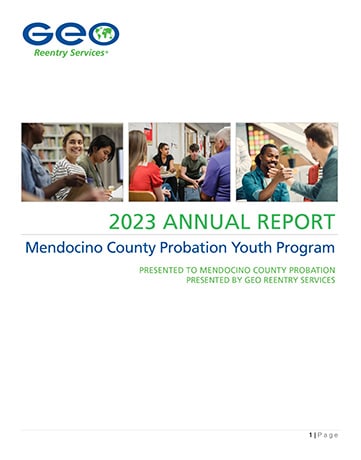
GEO Reentry operates a youth program for the county that delivers evidence-based reentry services at the Juvenile Hall as well as services for youth as they transition to the community. This report reviews programmatic details as well as data dosage and participant demographics compiled during 2023. The program served 43 individuals during the year in three program levels, ranging from voluntary to mandated.
The Sacramento DRC provided services to 93 participants, with an average daily population of 24 over a one-year period, ending June 30, 2023. This report finds a significant change in participants, including a 21% reduction in risk score as measured by the LSI-R, significant employment gains from when a participant entered the program until completion, and a positive discharge for 91% of individuals who exited the program.
This report assesses data for one year ending June 30, 2023, for a program that provides in-custody cognitive behavioral treatment and training. At fiscal yearend, 173 participants were involved with the program. This report assesses the results of 165 individuals discharged, key events at the center, staff training initiatives and milestones and other performance measures the DOC established. In an assessment of 128 participants at SWICC and 3 other in-custody programs in Illinois, there was a 15% reduction in assessed criminal risk using the Texas Christian University Criminal Thinking Scales instrument. Researchers calculated more than $7 million was saved by the state through reduced incarceration costs too.
This report assesses data for one year ending June 30, 2023, for a program that provides in-custody cognitive behavioral treatment and training. At fiscal yearend, 173 participants were involved with the program. This report assesses the results of 274 individuals discharged, and only 18% were unsuccessfully discharged. It also reviews staff training initiatives and performance measures the DOC established. In an assessment of 128 participants at the Jacksonville Correctional Center and 3 other in-custody programs in Illinois, there was a 15% reduction in assessed criminal risk using the Texas Christian University Criminal Thinking Scales instrument. Researchers calculated the state saved more than $3.2 million through reduced incarceration costs.
This report assesses data for one year ending June 30, 2023, for a program that provides in-custody cognitive behavioral treatment. Of the 135 individuals discharged from the program during the year, only 18% failed for disciplinary reasons. In an assessment of 128 participants at Taylorville Correctional Center and 3 other in-custody programs in Illinois, there was a 15% reduction in assessed criminal risk using the Texas Christian University Criminal Thinking Scales instrument.
This report assesses data for one year ending June 30, 2023, for a program that provides in-custody cognitive behavioral treatment. Of the 135 individuals discharged from the program during the year, 72% successfully completed the program and only 21% were discharged for disciplinary reasons. In an assessment of 128 participants at Graham Correctional Center and 3 other in-custody programs in Illinois, there was a 15% reduction in assessed criminal risk using the Texas Christian University Criminal Thinking Scales instrument.
A 45-page independent study by EvalCorp, measuring recidivism and rearrest data over several years, service participation levels, and participant satisfaction, found the Adult Reporting and Resource Centers in Ventura County are producing positive results. The study also concluded that the longer participants remained in the program, the better the outcomes.
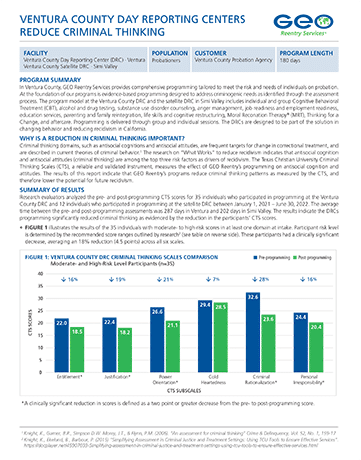
GEO Reentry operates two DRCs for the probation department, in Ventura and in Simi Valley, and duration for participants is typically 180 days. This report assesses pre- and post-programming data for 47 program participants over an 18-month period, ending June 30, 2022. Applying the Texas Christian University’s Criminal Thinking Scales tool, researchers found an 18% criminal risk reduction for moderate- and high-risk participants across six domains at the Ventura location and a 13% reduction for the same population assessed in Simi Valley.
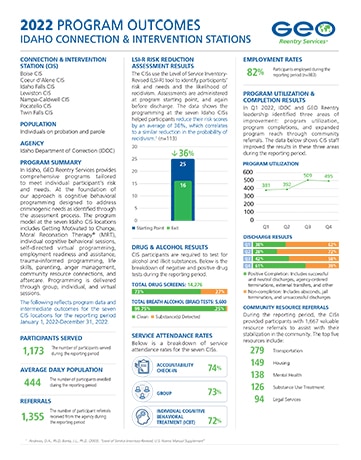
GEO Reentry operates seven centers in Idaho that deliver evidence-based treatment and reentry services. This report assesses pre- and post-programming data during the calendar year 2022 for program participants as well as data points on accountability services. The seven centers served 1,173 participants during the year, and there was a 36% risk reduction as measured by the LSI-R for a sample population measured. Other factors such as number of drug and alcohol screens, employment gains, attendance rates, and referrals made from the center were assessed as well.
Since 2010, GEO Reentry has operated the RSC for the probation department. This report assesses data points for 140 participants who entered the program in calendar year 2022. It finds very positive engagement results, including an 87% accountability check-in rate, lower substance abuse rates, 54% employment gains, and positive program discharges. Of importance, when assessing 70 successful program completions during this year, there was a 41% risk reduction as measured by the LSI-R.
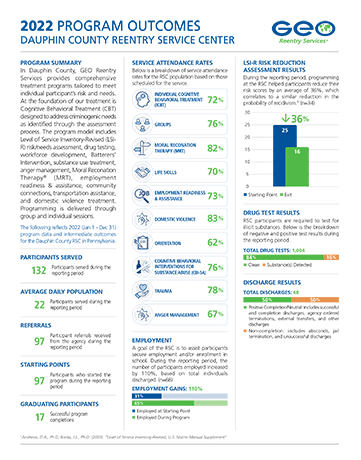
For more than a decade, GEO Reentry has operated the RSC for the probation department. This report assesses data points for 132 participants who entered the program in calendar year 2022. It finds very positive attendance rates, more than 1,000 drug tests administered and only 16% positives, and employment gains of 110% for discharged participants. Importantly, when assessing a sample 34 program participants during this year, there was a 36% risk reduction as measured by the LSI-R.
GEO Reentry provided reentry services during calendar year 2022 to 703 individuals on parole. While full in-person services did not resume until the end of 2022, the CRC services remained impactful for participants. This report assesses attendance rates, drug tests, referrals made to outside community resources, employment, and risk levels. Assessing pre- and post-program data, the report found major gains among participants reducing risk levels which in turn reduce recidivism.
For more than a decade, GEO Reentry has operated the RSC for the probation department. This report assesses data points for 259 participants who entered the program in calendar year 2022. It finds very positive engagement results, including a 96% accountability check-in rate, lower substance abuse rates, significant employment gains, and positive program discharges. Of note, when assessing 63 successful program completions during this year, there was a 28% risk reduction as measured by the LSI-R.
California Department of Corrections & Rehabilitation | April 2022
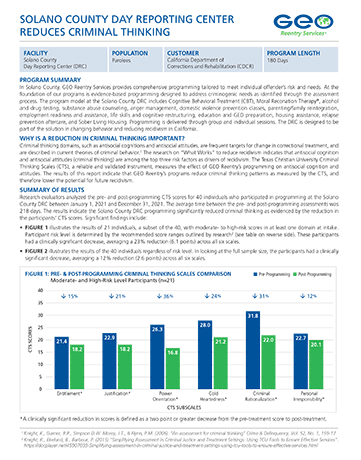
This report assesses pre- and post-programming data for 40 parolee program participants during the calendar year 2021. The average time between assessments was 218 days. Applying the Texas Christian University’s Criminal Thinking Scales tool, researchers found a criminal risk reduction averaging 12% over six domains. For a moderate- and high-risk subset of participants, the risk reduction jumped to 23%.
GEO Reentry has operated the Shasta County DRC for the probation department for 10 years. This report assesses outcomes data over a 12-month period ending April 7, 2022. Measuring pre- and post-programming data for 58 program participants applying the Texas Christian University’s Criminal Thinking Scales tool, researchers found a criminal risk reduction averaging 14% over six domains. For moderate- and high-risk subset of participants, results were even more dramatic.
GEO Reentry operates two DRCs for the Orange County Probation Department. This report assesses outcomes data over an 18-month period ending June 30, 2022, for both centers. During this time almost 500 individuals were served. The report finds positive results in participant attendance, discharge data, and community referrals. Most importantly, using pre- and post-program data, participants had lower criminal risk scores using two trusted assessments tools.
Louisville Metro Department of Corrections | September 2022
The Louisville Metro Criminal Justice Commission opened the RSC as a cost-effective alternative to incarceration that could also reduce recidivism. This outcomes report captured data during the calendar year 2021, and finds the program reduced criminal risk among participants significantly, had excellent engagement as measured by attendance at services, achieved high employment gains and helped the agency save more than $1 million in jail-avoidance costs.
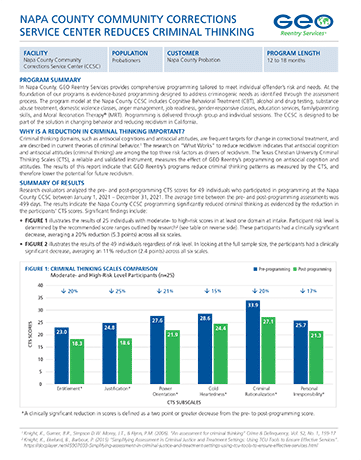
Participants at the Napa County Community Corrections Service Center are typically involved in the program from a year to 18 months. This report assesses 49 participants during the calendar year 2021 and found an 11% reduction in criminal thinking for all of these 49 individuals using the Texas Christian University’s Criminal Thinking Scales assessment tool. When measuring results for 25 of these individuals who were considered high- or moderate-risk, the results were even more impressive.
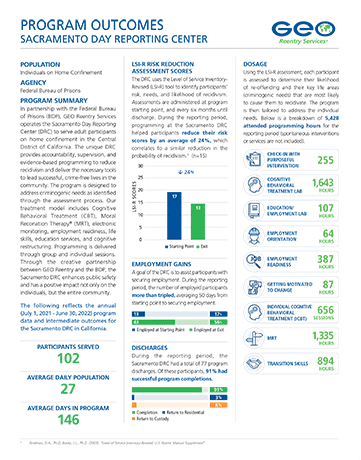
The Sacramento DRC delivers evidence-based treatment programs designed to reduce criminal behavior. This report measures results over 12 months, ending June 30, 2022, and finds significant change in the 102 participants served, including a 24% reduction in risk score, significant employment gains from when a participant entered the program until the time they exited it, and high satisfaction marks through a participant survey.
California Department of Corrections & Rehabilitation | April 2022
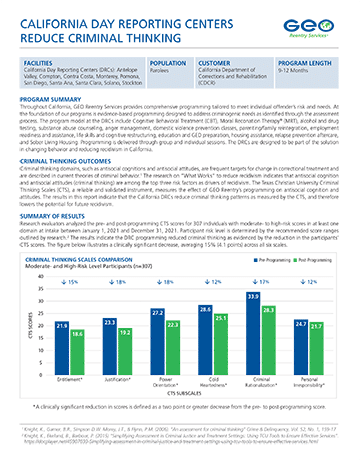
This report assesses the pre- and post-result assessments of 307 adults on parole at 10 California Day Reporting Centers over the course of 2021. Researchers found criminal thinking decreased within the studied group by an average of 15%, using The Criminal Thinking Scales tool developed by Texas Christian University.
Despite the pandemic, GEO Reentry provided reentry services during calendar year 2021 to 626 individuals on parole. This report assesses data points for these participants, looking at services provided, including treatment groups delivered and referrals to community resources made. Assessing pre- and post-program data, the report found major gains among participants in finding jobs and significant risk level reductions using both the LSI-R and the Texas Christian University Criminal Thinking Scales across six domains measuring antisocial cognition and attitudes.
Luzerne County Department of Probation Services | April 2022
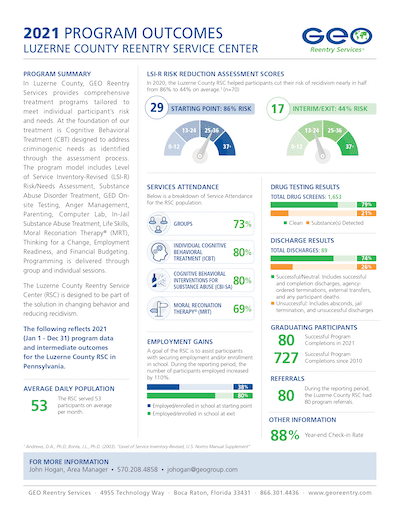
This report analyzes 2021 data from the center, leading with an assessed risk of 86% when a participant enters the program to a risk score of 44% upon program completion. Among other factors, the report also highlights significant gains in employment for the 80 program graduates.
Lycoming County Adult Probation Office | April 2022
A new outcomes report for this reentry program focused on participant data for calendar year 2021. More than 178 individuals successfully completed the program in 2021. Also highlighted are big gains in employment for participants, high levels of engagement, and significant improvement in antisocial cognition and attitudes due to programming.
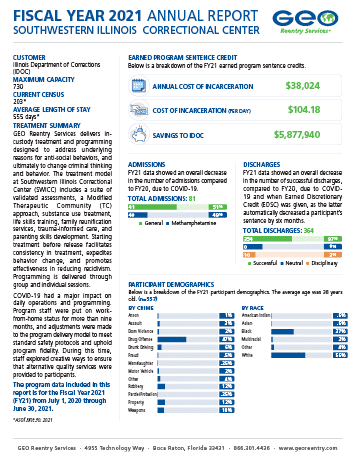
The in-custody treatment program at Southwestern Illinois Correctional Center suspended in-person services due to the pandemic. This new report, based on program data from July 1, 2020, through June 30, 2021, reflects that, while COVID-19 did impact daily operations, both participants and staff experienced positive outcomes after adjustments were made to ensure program fidelity and participant safety. Audit results indicating 100% compliance in all performance measures help illustrate that staff’s attempts to adapt the program were successful.
Illinois has been focused on reentry efforts for more than two decades, and this new report spanning services delivered in 2020 assesses how participants performed in key areas, such as criminogenic risk, employment, substance abuse usage, and overall engagement with the activities six Chicago-area reentry programs deliver. Risk scores were reduced by half for the 500+ participant sample size—meaning participants were much less likely to recidivate—and other significant gains were recorded.
Luzerne County Department of Probation Services | April 2021
Established in 2010 to help alleviate jail crowding and reduce chronic recidivism, this reentry program has become an important component of the local criminal justice system. This report analyzes 2020 data from the center, and highlights employment gains, reduced risk scores, and other key service factors for program participants.
Lycoming County Adult Probation Office | January 2021
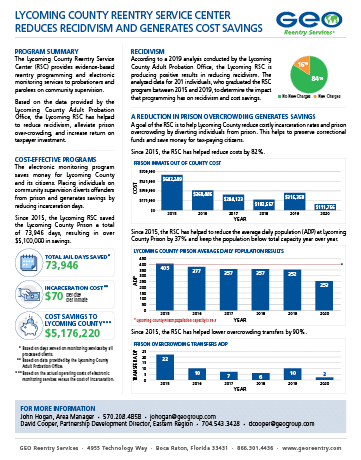
The Lycoming Reentry Service Center provides evidence-based reentry programming and electronic monitoring for individuals on community supervision. Program participants receive cognitive behavioral treatment and training to change criminal thinking. This report analyzes data for 201 individuals who graduated the program between 2015 and 2019. Results found decreased recidivism and increased cost savings.
Across six GEO Reentry-managed Reentry Service Centers, which provide non-residential treatment and training, researchers assessed a number of critical factors, including recidivism reduction, feedback from participants on staff performance, drug positivity rates, and job placement upon program completion. The results were impressive, including a risk reduction across each of six criminogenic factors.
The Leidel Residential Reentry Center provides transitional services for males and females returning from prison. These services focus on reducing criminal thinking and enhancing successful reentry to community life. This outcomes report assesses the pre- and post-treatment risk scores from a sample of 77 participants in 2019. The results found a significant drop in criminal risk.
In addition to other reentry initiatives, the New Jersey State Parole Board funds Community Resource Centers where parolee reentry services are delivered. GEO Reentry operates five of these NJ CRC programs. This outcomes report examines the pre-treatment and post-treatment risk scores for 256 participants who completed programming at one of these five CRC programs between Jan. 1, 2019 and Dec. 10, 2019. The results were dramatic, with those studied having a 29% risk reduction score after completing evidence-based treatment and training.
Louisville Metro Department of Corrections | March 2020
Opened in 2011, the implementation of a day reporting program was a goal of the Louisville Metro Criminal Justice Commission to develop more cost-effective alternatives to incarceration that assist in reducing recidivism. This outcomes report finds the program is reducing the risk of participants to recidivate, lowering costs through jail avoidance, preparing participants to find jobs, and receiving high marks from participants as well.
To help prepare inmates for successful reentry, the Las Vegas Metropolitan Police Department opened an in-custody reentry program in the Clark County Detention Center for inmates nearing the end of their time incarcerated. This outcomes report assesses the results of pre- and post-treatment changes in risk scores for participants using Level of Service Inventory-Revised®, Criminal Thinking Scales, and Victim Impact Scales. With each measurement tool, participant risk scores improved.
Illinois Department of Corrections | December 2019
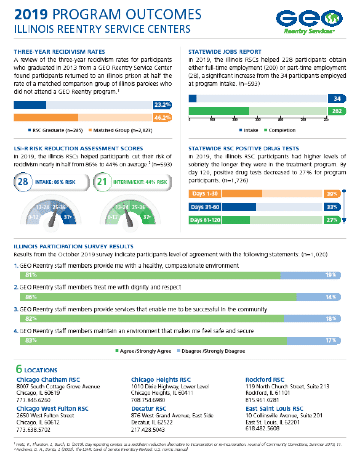
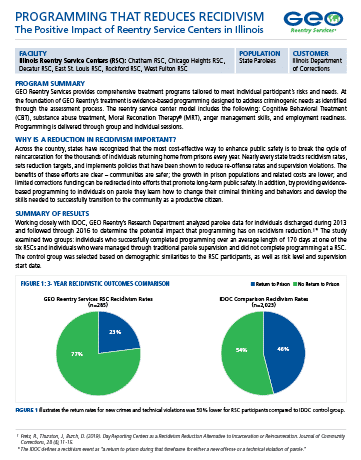
Nationwide, states recognize that the most cost-effective way to enhance public safety is to break the cycle of reincarceration after individuals return from prison to the community. Illinois has been focused on reentry efforts for more than two decades. In this report, researchers analyzed data over three years for discharged parolees who went through six GEO Reentry programs in Illinois versus a control group. The risk-score reductions were dramatic.
California Department of Corrections & Rehabilitation | November 2019
The evaluators analyzed the pre-treatment and post-treatment CTS scores for 240 participants from the Pomona DRC. The participants were treated at the DRC between 2015 and 2018. The average treatment episode for the participants was approximately eight months. The participants had a significant decrease, both clinically and statistically, averaging an 8% reduction (2 points) across the six scales. The results indicated that the programming at the Pomona DRC significantly reduced criminal thinking for participants in the moderate- to high-risk sample as evidenced by the changes in their CTS scores from pre-test to post-test.
California Department of Corrections & Rehabilitation | November 2019
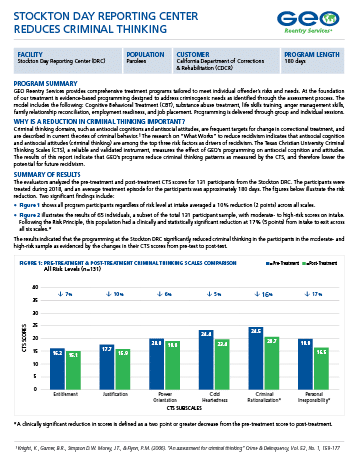
The evaluators analyzed the pre-treatment and post-treatment CTS scores for 131 participants from the Stockton DRC. The participants were treated during 2018, and an average treatment episode for the participants was approximately 180 days. The results indicated that the programming at the Stockton DRC significantly reduced criminal thinking in the participants in the moderate- and high-risk sample as evidenced by the changes in their CTS scores from pre-test to post-test.
North Carolina Department of Corrections | February 2018
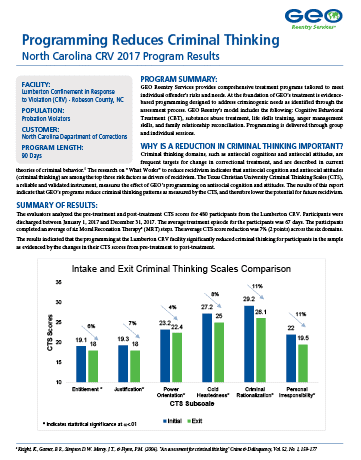
The Justice Reinvestment Act of 2011 led to significant changes in sentencing laws in North Carolina, changes that led to revisions in practices set 20 years prior. The state decided, rather than returning technical probation violators to incarceration with no services, to return violators to unique in-custody facilities for in-prison programming for up to 90 days. In analyzing 480 program participants in 2017, this report explores how North Carolina’s Confinement in Response to Violation Center in Lumberton has reduced criminal thinking significantly between pre- and post-treatment.
North Carolina Department of Corrections | February 2018
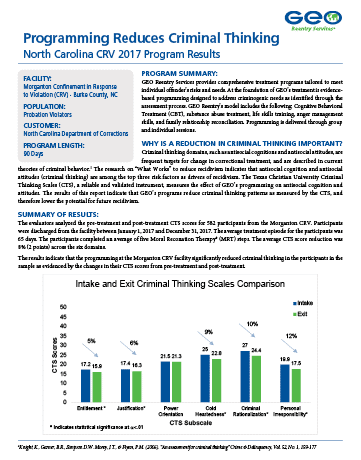
In North Carolina’s Confinement in Response to Violation Centers, GEO Reentry uses the Texas Christian University Criminal Thinking Scales (CTS) to measure the effect of programming on antisocial cognition and attitudes. In analyzing 582 program participants who attended the Morganton CRV, this report explores how programming has reduced criminal thinking significantly between pre- and post-treatment.
Assessing outcomes data is an important factor in evaluating the value of a reentry program for a jurisdiction. The Kern County Probation Department, with the assistance of its Research, Analysis and Data Unit, reviewed outcomes data from its Day Reporting Center program over a two-year period. The DRC, a non-residential program designed for medium- to high-risk probationers, achieved positive results in the study. Assessing three groups: DRC graduates; probationers who had received at least 90 days of programming; and a control group that received no DRC services, found only 30% of graduates recidivated while the control group recidivated at a 53% rate. Additionally, the data showed graduates who did recidivate were typically convicted of lesser offenses than the other groups assessed.
Illinois Department of Corrections | November 2017
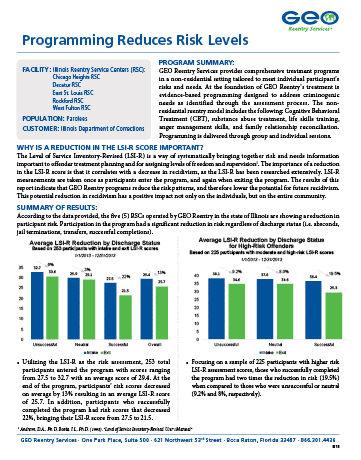
The Illinois DOC funds reentry service centers statewide for parolees returning to community life. In these RSC programs, parolees receive evidence-based programming, including cognitive behavioral treatment, in a non-residential setting. A key to a participants’ success is reducing their level of risk. GEO Reentry Services, which operates the RSC programs, uses the LSI-R tool to assess risk levels. This study, assessing 253 program participants in five RSCs, found that their risk levels had dropped 13% in assessed risk when they participated in RSC programming. For parolees who completed the program, their assessed risk dropped further, with their risk levels reduced by 22%. Additionally, for 225 participants deemed at high-risk for recidivating who completed the program, their risk score dropped an impressive 19.5%.
Pennsylvania Department of Corrections | October 2017
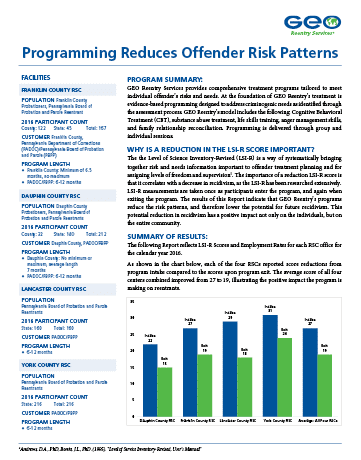
Reducing offender risk and focusing on stable employment are key factors for participants in reentry services. This study reviews four non-residential reentry service centers in Pennsylvania, including Franklin County RSC, Dauphin County RSC, Lancaster County RSC, and York County RSC. Participants in this study group had their risk scores—measured by the LSI-Revised—drop by 29.6%, moving these participants from what many consider at high to medium risk of recidivating. Additionally, an average of 71.9% of reentrants obtained employment while at the reentry service centers.